What is Marvel?
Marvel is three things that people use one word for: a comics publisher, a film studio, and a set of characters other studios still partly own. The last one is why a watch order is hard.
1939
A comics publisher
Timely Comics, later Marvel. Decades of characters built to cross over. That habit is exactly what makes a screen order complicated later.
1990s
Then it sold them off
Near bankruptcy in the nineties, Marvel licensed its best-known characters to other studios to raise cash. Those deals are the reason the rest of this page exists.
2008
So it made films itself
Left with the characters nobody had licensed, Marvel financed Iron Man on the strength of what remained, and built a connected universe out of the leftovers.
2015
Others kept building too
Fox ran the X-Men, Sony ran Spider-Man, Netflix ran thirteen seasons of street-level television. Four studios telling one story at once, none of them obliged to agree.
Now
It is still being untangled
Disney has bought most of it back and lent some of it out again. The map is smaller than it was and it is not one map yet.
The two people behind it
 Co-creatorStan Lee1922–2018Co-created most of the characters on this site, at Marvel Comics, largely between 1961 and 1972.
He was writing filler for a company that was about to fold when he was told to make a superhero team to compete with the Justice League. He wrote the Fantastic Four as a family that argued, and then spent eleven years doing the same thing to every archetype he touched: a teenager who could not pay rent, a scientist afraid of himself, a billionaire with a heart condition. The idea that a superhero has an ordinary problem is his, and it is why any of this survived the sixties. He died in November 2018, aged 95.
Characters he co-created
Mostly with Jack Kirby and Steve Ditko, who drew them and shaped them at least as much — a credit Lee spent decades being argued with about, and one this page states rather than steps around.
- Cameos
- He appears in almost every Marvel Studios film from 2008 onward, and in several of the Fox and Sony ones. His last filmed cameo was in Avengers: Endgame; the animated Spider-Verse films kept finding ways to include him after he died.
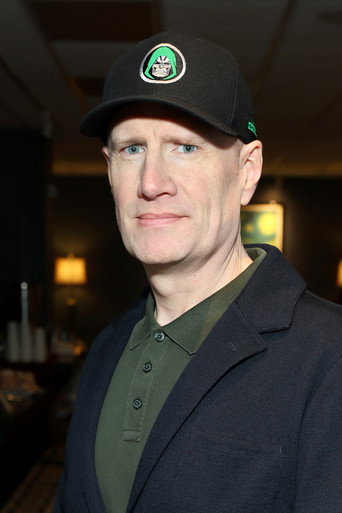 President, Marvel StudiosKevin Feigeb. 1973The films connect to each other because one man decided in 2007 that they would.
He was an assistant on the first X-Men film and president of Marvel Studios by 2007, a year before Iron Man. The decision that defines this entire site is his: that these films would share one continuity, in public, with a schedule announced years in advance. Nobody had attempted it at that scale. Every studio has been trying to copy it since, and none has managed it.
- What he actually did
- Announced Phase One as a plan rather than a hope, put a post-credits scene in Iron Man promising a team-up four years out, and then delivered it. The thread this site maps is the one he tied.
One story, eight sets of rights
Marvel sold its characters off to survive the nineties. Everything confusing about the order comes from that, and from getting them back one studio at a time.
1996
Marvel Entertainment files for bankruptcy protection. It starts selling film rights to its characters to raise cash, each deal carrying a reversion clause: make a film within a set number of years or the rights come back.
1996
New Line takes Blade. Fox takes X-Men, Fantastic Four and Daredevil. Universal takes Hulk and Namor. Lionsgate takes Punisher, Black Widow and Man-Thing. Sony takes Ghost Rider.
1998
Blade opens and makes money. It is the first Marvel film that works, and it is the reason anyone financed the rest.
1999
The Spider-Man litigation ends and Marvel licenses him to Sony for a reported seven to ten million dollars. The licence covers roughly nine hundred related characters, which is why Venom, Kraven and every Spider-Man villain belong to Sony rather than to Marvel.
2000
Fox releases X-Men. The mutants become a film franchise on a separate track from everything Marvel will later build, and they stay there for nineteen years.
2003

The Hulk film rights revert to Marvel. Universal keeps distribution rights, which it still holds. That is the actual reason there has never been a second solo Hulk film.
2005
Marvel raises finance against the characters nobody had licensed, and starts Marvel Studios to make films itself. The collateral list is why the MCU begins with Iron Man rather than with Spider-Man or the X-Men.
2008

Iron Man opens. The Incredible Hulk follows the same year, distributed by Universal, which is why it sits slightly apart from everything after it.
2009
Disney buys Marvel Entertainment for four billion dollars. It does not buy back any of the licences, so nothing about the split changes yet.
2013

Distribution of the Iron Man, Thor and Captain America films returns from Paramount to Disney.
2015
Sony and Marvel Studios agree to share Spider-Man. He enters the MCU in Civil War while Sony keeps the character and the wider licence, which is why he can be in both places at once.
2015
Marvel Television starts making series for ABC, Freeform, Hulu and Netflix. It is a different company under a different executive from the studio making the films.
2019
Disney completes its acquisition of 20th Century Fox. X-Men, Deadpool and the Fantastic Four come home after two decades away.
2019
Marvel Television is absorbed into Marvel Studios and its shows lose canon status. That is why Agents of S.H.I.E.L.D. and the rest sit in their own universe here rather than beside Endgame.
2022
The Netflix series revert to Disney and move to Disney+. Daredevil returns to the films two years later.
2024
Deadpool & Wolverine opens. It is the first film with Fox characters made by Marvel Studios, and it reaches back across two decades of a rival studio's continuity to do it.
This is why the order is hard
One story, eight sets of rights. That is the whole problem, and it is why this site has eight universes rather than one list.
See every universe